

In a recently published post, BondagePal.com Founder David Minns offers a detailed breakdown of using AI to create fetish imagery, covering the steps involved – as well as the low cost of such production methods, when compared with creating similar images using paid models, set props and traditional image editing methods.
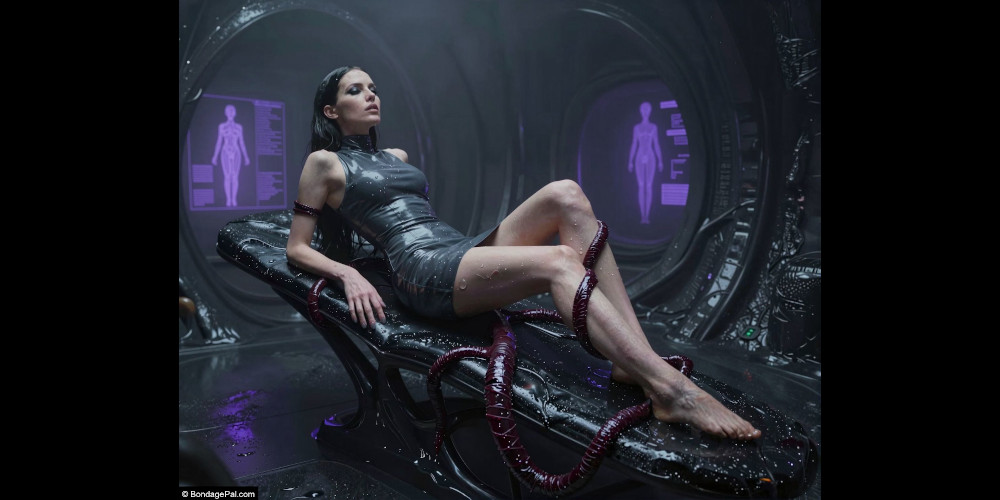
“Independent publishers are increasingly replacing expensive fetish photography with AI-generated imagery at scale, transforming adult marketing, niche dating platforms, SEO publishing, and digital content production,” Minns notes. “In this example, the goal is to generate a cinematic scene featuring a woman in latex aboard an alien spacecraft, surrounded by biomechanical tentacles during a futuristic examination sequence.”
In his post, Minns writes that “before AI image generation became widely accessible, producing a scene like this required extensive planning and a large creative team.”
“You would typically need a custom location or set design, a model, wardrobe styling, makeup and special effects artists, a professional photographer, lighting equipment, and often a photo retoucher or digital artist for post-production,” Minns observes, offering a chart with estimated production costs of creating high-end fetish images through traditional means.
Minns also points out that “this type of project is not well suited to mainstream AI image platforms such as OpenAI’s ChatGPT image tools or Elon Musk’s Grok.”
“While these systems are extremely capable, they include a number of restrictions and limitations designed to prevent misuse,” Minns writes. “These safeguards are understandable and important for public platforms, but they can make highly specific creative workflows unreliable. Even when a project does not contain nudity, certain keywords, themes, or visual compositions may still activate moderation systems and interrupt the generation process.”
Minns advocates for a process that begins by creating the basic environment for the scene being depicted, observing that just as with a real photoshoot, “every scene starts with the right location.”
“With AI image creation, there is no need to scout sets, hire crews, or build expensive props,” Minns writes. “You create the entire environment using descriptive prompts. Start by deciding on the mood and style you want. Think about lighting, materials, colors, and atmosphere. The more specific your description, the more immersive the final image will feel.”
After creating your environment (Minns provides a detailed example of the prompts one would use to do so), he touches on the process of creating the model, suggesting a prompt that is equally mindful of detail, including instruction on “age, eye color, hair style, body shape, piercings (and) tattoos, amongst other things.” A similar prompt is then needed to craft your model’s wardrobe.
Minns also observes that generating AI images is an “iterative process.”
“AI image generation is rarely perfect on the first attempt,” Minns writes. “Creating high-quality results is usually an iterative process that involves refining prompts, adjusting settings, and sometimes choosing an alternative approach when the desired output cannot be achieved consistently.”
Minns notes that in creating his example image set, AI made mistakes, underlining the importance of the iterative process and tweaking of your prompts to eliminate such errors.
“The tentacles wrapped around the arm created an artificial boundary, causing the model to interpret part of the skin surface as clothing material,” Minns writes, adding that “the overlapping leg position confused the model’s anatomical interpretation, resulting in a merged or partially duplicated foot structure.”
“In this project, creating the tentacles was very difficult,” Minns reports. “The AI model had a lot of trouble trying to get the tentacles to interact with the woman. “The end result looks impressive, however the model failed for white tentacles coming from the platform, the floor, floating orbs and many more permutations. Several frustrating hours were lost before a solution that worked could be found. This is certainly a limitation today, you can generate an image, but it may not be the exact image you want.”
After noting other advantages and disadvantages of using AI to create images in bulk and at scale, Minns delivers the upshot: “For independent publishers, developers, and niche content creators, AI image generation fundamentally changes what is possible.”
“Concepts that would previously have required large production budgets, specialist photography teams, custom sets, wardrobe sourcing, post-production editing, and significant logistical planning can now be produced locally on consumer hardware in a matter of hours,” Minns adds. “This does not remove the need for creativity or technical skill. In many ways, the role simply changes. Instead of directing photographers, lighting crews, and models, the creator directs prompts, environments, compositions, materials, and iterative refinements. The process becomes closer to digital art direction combined with software engineering.”
For those interested in learning more about using AI to generate any sort of images, fetish or otherwise, the full post is well worth reading carefully (and possibly repeatedly). Neither outlandish AI hype nor hyperventilating AI criticism, the article offers a practical assessment of the current state of using AI as a flexible and potent image-authoring tool.
Read “How AI Is Replacing Professional Fetish Photography” in full on BondagePal.com.
AI Image courtesy of BondagePal