

Most rankings of casino games are really rankings of production budgets. The games with the best animation win, the ones with a licensed soundtrack place well, and nobody prints the one number that decides what the night costs. So here is a league table built on that number alone. House edge, lowest to highest, with the arithmetic shown at both ends so you can check it rather than take it. Some of these are famous games with a price most players have never looked up. One of them costs roughly forty times what the game at the top of the table costs, per dollar you put through it.
House edge is a rate, not a verdict
House edge is the share of each wager the operator expects to keep over the long run. It’s a rate applied to money wagered, not to money you brought, and that distinction does most of the damage in practice.
RTP is the same number said backwards. A game at 98% RTP is a game with a 2% house edge; both statements describe one thing from opposite ends. Whichever way a site prints it, the arithmetic behind it is fixed: expected loss equals your average stake, times the edge, times the number of bets you make. Three inputs. Two of them are yours.
What the rate cannot tell you is what happens tonight. A 0.5% edge will happily take your whole session, and a 20% edge will occasionally hand you a good story. Over enough repetitions, though, the rate is the only thing that survives.
The table at the top: under 1%
- Blackjack with basic strategy on liberal rules: about 0.5%. Both halves of that sentence are load-bearing, and a table with worse rules is simply a different game with a different price.
- Free odds behind a craps pass line bet: 0%. The house takes nothing on that portion because it pays at true odds, which makes it the only genuinely unpriced bet on a casino floor.
Price out the top of the table. Blackjack at $10 a hand, seventy hands dealt in an hour, is $700 of action. Half a percent of $700 is $3.50. That is what an hour of correct play is expected to cost, and it is less than the drink.
Free odds deserve the asterisk, because you cannot bet them on their own. They ride behind a pass line bet that carries its own 1.41%, so what odds actually do is drag your blended rate down across your total action. The more of your money sitting on the zero-edge portion, the lower the average rate you are paying overall.
The middle band: 1% to 3%
- Baccarat banker: 1.06%, the cheapest bet on that table by a clear margin.
- Baccarat player: 1.24%. The gap to banker is 18 hundredths of a point, which is 18 cents per $100 wagered, so it only shows up over a long night.
- Craps pass line: 1.41%.
- In-house originals published at 98% RTP, which is a 2% edge.
- European roulette, single zero: 2.70%.
This band is where most sensible play lives, and it is wider inside than it looks from outside. Divide 2.70 by 1.06 and the expensive end of the band costs about two and a half times the cheap end. In cash, that is $2.70 against $1.06 on every $100 you push through.
The originals are worth a note. Jacks Club publishes RTP on every game tile, so a 98% figure on a house original converts straight to a 2% edge with no arithmetic needed beyond subtracting from 100. That puts them between baccarat and European roulette: dearer than a banker bet, cheaper than a single zero wheel, and a long way clear of everything in the next section.
The expensive end
- Slots: commonly 3% to 8%, and the figure is usually per game rather than per site.
- American roulette, double zero: 5.26%.
- Baccarat tie: 14.4%. Same table as the 1.06% bet, fourteen times the price.
- Keno: often 20% to 25% in land based versions. Online paytables vary widely, so the range is wider still and has to be read game by game.
Now the arithmetic at this end, because this is where it stops being abstract. Per $100 wagered, keno at 20% expects to keep $20, and at 25% it keeps $25. Blackjack at the top of the table expects to keep 50 cents from the same $100. Forty to fifty times the price for the same money staked.
The two roulette wheels make the cleanest comparison in gambling, because the game is otherwise identical. One extra pocket takes the edge from 2.70% to 5.26%. That is 2.56 points, or an extra $2.56 for every $100 through the wheel, and it is close enough to double that you can treat the second zero as a price tag rather than a design choice.
Bets per hour is the multiplier nobody prices in
Rate times volume. Everyone reads the rate and nobody reads the volume, and the volume is usually the bigger term.
A slot at a 4% edge spinning 600 times an hour, at one unit a spin, is 600 units of action and 24 units of expected cost. Blackjack at 0.5%, seventy hands an hour, same unit per bet: 70 units of action, 0.35 units expected cost. Divide one by the other and the slot costs about sixty-nine times as much per hour, at the same money per bet.
Split that factor in two and it gets clearer. The edge ratio is eight: 4 divided by 0.5. The bet-count ratio is about eight and a half: 600 over 70. Multiply the two and you land back on sixty-nine. Roughly half the damage is the game being worse, and roughly half is simply the speed at which you are allowed to play it, because nothing paces a slot while a shoe game paces itself with shuffling, payouts and other people at the table who are slower than you.
If you want to cut your hourly cost without changing what you play, the number to change is the number of bets. It is the only input in that formula that a casino has spent real engineering effort trying to raise.
Two games at the same edge can cost you very differently
Take two games both sitting at 98% RTP and a 2% edge. Play one 600 times an hour at a unit a go and it runs 12 units an hour. Play the other seventy times an hour at the same stake and it runs 1.4 units. Same edge, same stake, eight and a half times the cost, and the paytables were never the thing that separated them.
Variance is the second splitter. A 2% edge paid out in small frequent returns and a 2% edge paid out through one enormous rare multiplier are the same long-run rate attached to completely different short-run experiences. The second one has a median result far worse than its average, because the average is held up by an outcome most players never see.
Which is why reading RTP and house edge as a single fact about a game gets you about half the story. The rate tells you the price. Bet frequency tells you how fast you pay it, and the payout shape tells you whether the bill arrives evenly or all at once.
What this ranking cannot tell you
A few honest limits, because a table of percentages invites more confidence than it earns.
Every figure above is conditional. Blackjack’s 0.5% assumes basic strategy played correctly and a table with friendly rules; get either wrong and the number moves. Craps at 1.41% is the pass line specifically, not the proposition bets in the middle of the layout. Slot ranges are per title. Keno online has to be checked paytable by paytable rather than assumed from the land based range.
None of these rates predict a session. They describe the price of admission per dollar staked, averaged over a volume of play most people never reach in a year. Short runs do whatever they want, which is the entire reason anyone plays.
So use the table for what it is good for. Pick the game, check the published rate, decide your stake and roughly how many bets you intend to make, and you will know what the evening is expected to cost before you place the first one. Then place it knowing the price, which is the only part of this you ever controlled.
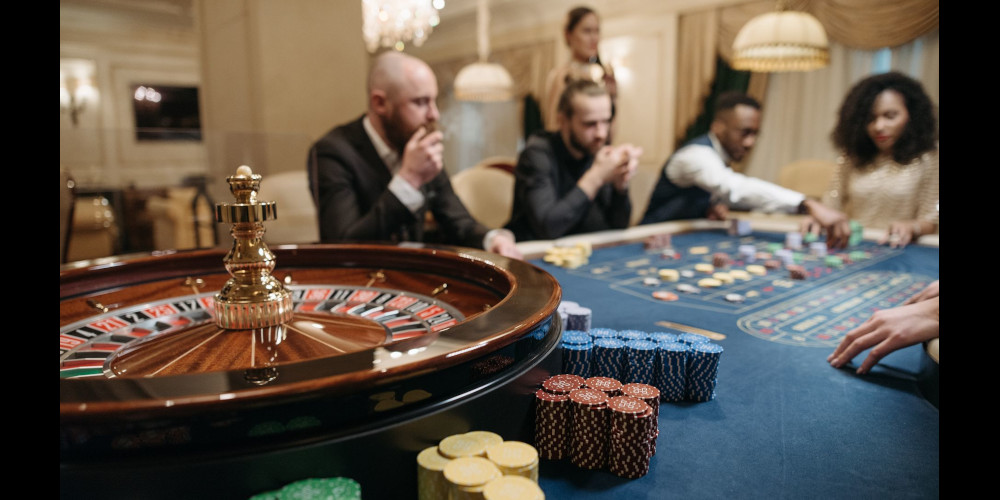
Casino image by Pavel Danilyuk from Pexels