

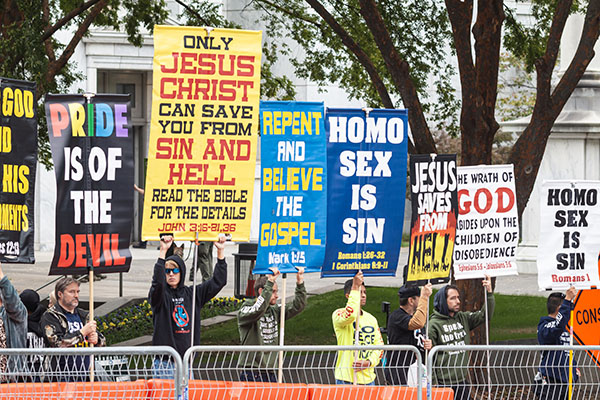
 Those of us in America find ourselves at the precipice of another presidential election, an event that seems to bring with it increasing amounts of uncertainty, instability and disruption with each new cycle. The 2024 cycle appears to be a choice between those with more socially liberal aspirations for America (live and let live), and those who want a more rigid understanding of what lifestyles and social behaviors will and will not be allowed in the United States. The adult industry thrives when the former approach also thrives, while the tool of speech suppression most commonly used by those who advocate for that second approach has historically been obscenity law.
Although obscenity prosecutions were once a somewhat common occurrence in America, under past Republican administrations primarily (i.e. Ronald Reagan and George H.W. Bush), their use declined as the Internet rose to prominence. That means many of the individuals who have grown online businesses in the adult industry haven’t known a world where obscenity prosecutions posed a significant threat to their income and, more importantly, their very freedom. With recent developments in conservative politics, including proposed anti-porn policies as defined by Project 2025, it’s time again to prepare for a possible future Internet where adult speech is targeted by religiously-motivated censors — zealots who have seized control of government with a mission to impose their way of life, as we just saw happen with the overturning of Roe vs. Wade.
With that in mind, YNOT has decided to author a series of articles that detail all the basics about obscenity law in America, including what it is, its history, important legal battles, how past administrations have used it to harass and even destroy adult businesses, the effect of the Internet on obscenity laws, and how things are changing… again. This article you’re reading now is the first in that series.
Understanding the intricacies of obscenity laws is crucial for anyone involved in the production, distribution, or consumption of adult content. These laws have evolved significantly over time and have played a pivotal role in shaping the landscape of adult entertainment in the United States.
Legal Definition of Obscenity
Let’s start with the absolute basics. In the United States, the current legal definition of obscenity is primarily determined by the Miller Test, established by the Supreme Court in Miller v. California (1973). According to this test, material is considered obscene if all of the following are found true:
- Prurient Interest: The average person, applying contemporary community standards, would find that the work, taken as a whole, appeals to the prurient interest.
- Patently Offensive: The work depicts or describes, in a patently offensive way, sexual conduct specifically defined by applicable state law.
- Lacks Serious Value: The work, taken as a whole, lacks serious literary, artistic, political, or scientific value.
That word “prurient” is ironically not exactly part of contemporary community standards in America these days, so what does it mean? It refers to an excessive or unhealthy interest in sexual matters. It is often used in a legal context to describe content that has an undue or morbid interest in sex, which can be a key factor in determining whether material is considered obscene. The term originates from the Latin word “pruriens,” meaning “itching” or “longing,” and in contemporary usage, it typically carries a negative connotation, implying a lewd or lascivious interest.
If this all sounds highly subjective, it’s because it is. Obscenity laws are akin to replacing speed limits with instructions to drive “the speed that an average person on this road would believe is reasonable.” In short there is no way to know if you have violated obscenity laws until a jury tells you if you have, at which point it’s too late.
Legal Consequences
Producing, distributing, or possessing (with intent to distribute) material deemed obscene can lead to severe legal consequences, including fines, imprisonment, and the forfeiture of property used in the production or distribution of such material. These legal ramifications underscore the importance of understanding what constitutes obscenity under U.S. law, and therefore how disturbing it is that such understanding can be so elusive.
How bad could the consequences be though, right?
Bad, and we’ll get into this in more detail later on in this series. For the moment, consider the case of the late Max Hardcore who was sentenced to 46 months in prison following his conviction on multiple obscenity charges in 2008, right at the end of the George W. Bush administration. His sentence was later reduced to 41 months upon appeal. Hardcore’s case brought significant attention to the complexities of defining and prosecuting obscenity under U.S. law, and the potential consequences for those who are convicted.
Historical Context: Early Obscenity Laws and Their Origins
How did we get here with obscenity laws? The origins in America go all the way back to its founding.
Colonial and Early American Period
Obscenity laws in America have their roots in colonial times, when early settlers brought with them English common law traditions that sought to suppress immoral behavior. Early American obscenity laws were purportedly concerned with maintaining public morals and preventing the corruption of society, however it’s important to note that Christian religious views heavily influenced these laws, reflecting the prevailing attitudes of the time. Early statutes often targeted blasphemous, profane, and sexually explicit material, with severe punishments for violators, including public shaming, fines, and imprisonment. These laws aimed to define the moral fabric of the community and ensure that individuals adhered to accepted Christian standards of “decency.”
Comstock Laws
A significant milestone in the history of American obscenity law was the enactment of the Comstock Laws in 1873. Named after Anthony Comstock, a zealous advocate for moral “purity,” these laws prohibited the distribution of obscene materials through the mail. Comstock, who was appointed as a special agent of the U.S. Post Office, wielded considerable power to inspect and confiscate materials deemed obscene. His efforts led to the destruction of tons of books, pamphlets, photographs, and other materials.
The Comstock Laws were not limited to sexually explicit content; they also targeted contraceptives, abortion information, and anything Comstock considered morally corrupting. This broad interpretation allowed for extensive censorship and control over a wide range of publications and personal correspondence. Comstock’s crusade against obscenity was so intense that it significantly impacted the literary and artistic communities, leading to self-censorship among authors and publishers who feared legal repercussions.
The Comstock Laws were instrumental in shaping the legal and cultural landscape of the late 19th and early 20th centuries. They provided a framework for the federal government to regulate morality and paved the way for subsequent legal battles over obscenity. These laws remained in effect for many decades, with various amendments and interpretations influencing their enforcement. The legacy of the Comstock Laws is evident in the ongoing debates over censorship, free speech, and the regulation of adult content, reflecting the enduring tension between moral standards and individual freedoms.
Early 20th Century
In the early 20th century, the legal landscape began to shift with cases like United States v. One Book Called Ulysses (1933), which challenged the broad application of obscenity laws. This period also saw the development of the Hicklin Test, derived from the British case Regina v. Hicklin (1868), which defined obscene material as anything that could corrupt those whose minds are open to such immoral influences.
Shift from Hicklin to Roth
The Hicklin Test dominated American obscenity law until the landmark Supreme Court case Roth v. United States (1957). This case redefined the standards for obscenity by focusing on whether the material in question appealed to prurient interest and lacked redeeming social importance.
The Roth decision was a turning point, as it established that obscenity was not protected by the First Amendment. This case laid the groundwork for future legal battles and set the stage for the development of the Miller Test, which remains the standard today.
What Now?
The primary goal of this series is to share the history and evolution of obscenity laws in America, with a particular focus on adult content, and with an eye on the future of the adult business. By examining significant cases and legal standards around obscenity, the aim is to provide a thorough understanding of how these laws have impacted the adult entertainment industry and shaped societal attitudes towards obscenity — and insights into how they could evolve and impact the future.
In future entries to this series we’ll cover various aspects of obscenity law, including:
The early years and the origins of obscenity laws
The development of modern obscenity standards
The Golden Age of pornography and subsequent legal battles
The Reagan era and the war on pornography
The rise of the internet and its challenges
The 21st-century landscape and evolving standards
The impact on creators and the industry
The constitutional debate over obscenity and free speech
Now you have a foundation for understanding the complex and evolving nature of obscenity laws in America. From early colonial regulations to the pivotal Miller Test, obscenity laws have continually adapted to societal changes and technological advancements — and might adapt again.
Stay tuned for the next article in our series, where we will delve into the early years of obscenity laws in America. We will explore the origins of these laws during the colonial period, the influence of the Comstock Laws, and the early 20th-century cases that began to challenge traditional notions of obscenity.