


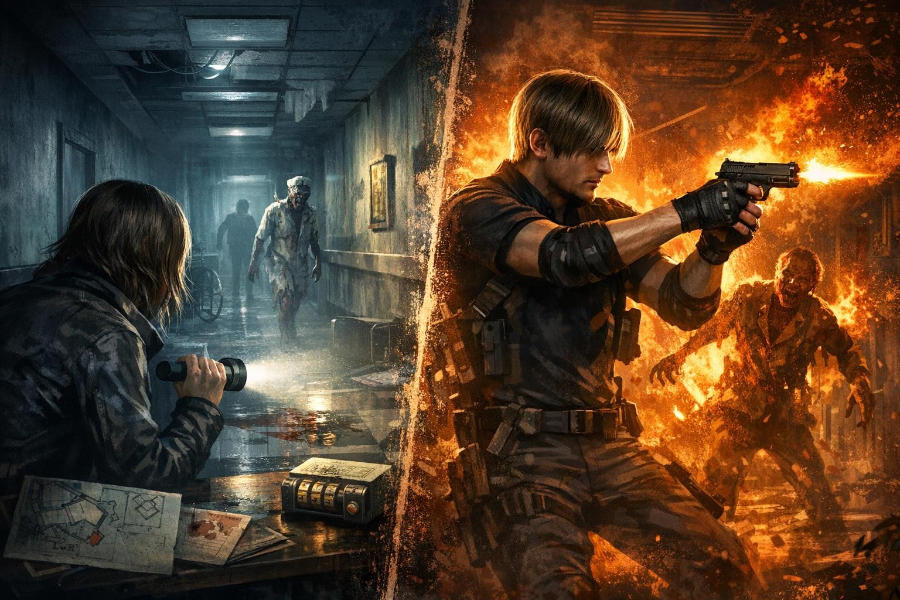
Resident Evil Requiem, the ninth mainline entry in Capcom’s horror franchise, attempts something the series hasn’t tried since 2012’s divisive Resident Evil 6: blending survival horror and action into a single cohesive experience. Set in the zombie-overrun Rhodes Hill Clinic (described by some as Raccoon City Hospital), the game features dual protagonists with distinctly different gameplay styles—FBI analyst Grace Ashcroft represents classic survival horror, while returning series veteran Leon S. Kennedy delivers the action-heavy experience fans expect from his appearances.
Based on extensive hands-on previews, Requiem appears to have learned from past missteps. Rather than forcing both genres into an awkward compromise, Capcom has designed each character around their respective strengths, creating what multiple outlets describe as “two games in one.” The approach has generated cautious optimism from critics who remember RE6’s failed attempt at similar genre fusion.
Early impressions suggest this dual-character structure works better than expected, with reviewers praising how the contrasting gameplay styles enhance each other. Grace’s vulnerable, puzzle-focused sections build tension that Leon’s explosive sequences then release, creating a rhythm that feels both familiar and fresh for longtime series fans.
Critical Consensus
Critics universally praise Requiem’s visual presentation and technical execution. Built on Capcom’s RE Engine, the game showcases exceptional environmental detail, character animation, and atmospheric lighting. Ian Dean (Creative Bloq) notes how “advanced lighting, physically based materials, detailed animation, and careful optimisation are all present, but they’re never showy. They exist to support framing, mood, and emotional response.”
The dual-protagonist structure receives widespread approval for its execution, even from reviewers initially skeptical of the concept. Ashley (GamesRadar+) observes that “Grace is meant to represent the player more realistically than any other Resident Evil protagonist,” while Xbox Wire emphasizes how “each character leans into the series’ two distinct signature gameplay styles of survival and action.” The perspective system—first-person for Grace by default, third-person for Leon—effectively reinforces their different roles and capabilities.
Most reviewers agree that Requiem successfully captures the essence of classic Resident Evil while modernizing key elements. The Rhodes Hill Clinic setting evokes the Spencer Mansion and RPD station with its intricate layout, elaborate puzzles, and interconnected areas. PCGamesN notes that “despite being entirely new, the Rhodes Hill Clinic feels familiar. Like the police department and Spencer Mansion, the clinic is vast and complex, full of dead ends and elaborate puzzles.”
Highlights from Early Reviews
- Exceptional visual design and atmosphere: Critics consistently praise the RE Engine’s material work, lighting systems, and environmental storytelling that creates unease before any enemies appear.
- Effective dual-protagonist system: The contrasting gameplay styles between Grace’s survival horror and Leon’s action sequences create a compelling rhythm.
- Sophisticated enemy design: Zombies retain traces of their former lives, performing hollow pantomimes of their previous duties as doctors, nurses, and staff.
- Classic Resident Evil puzzle design: Complex, interconnected layouts requiring ornate keys and cryptic clues hidden in documents.
- Innovative crafting system: Grace can extract zombie blood to create ammunition and resources, adding strategic depth.
- Dynamic lighting mechanics: Light affects enemy behavior, creating stealth opportunities and functional gameplay elements.
- Satisfying combat variety: Leon’s sections feature chainsaw combat, hatchet executions, and the return of RE4-style parrying.
- Immersive character portrayal: Grace’s ragged breathing, shaking hands, and realistic fear responses enhance player connection.
- Environmental storytelling: The clinic’s spaces tell stories through visual design before dialogue or exposition.
- Flexible camera system: Players can switch between first and third-person perspectives for both characters.
- Returning classic mechanics: Inventory management, item storage, and familiar progression systems from earlier games.
- Varied enemy encounters: Multiple stalker-type enemies with localized territories rather than omnipresent threats.
Criticisms
- Grace’s characterization concerns: PCGamesN criticizes her as “a weak, timid girl in need of saving” rather than a capable protagonist like Claire from RE2.
- Limited combat options for Grace: Her inability to dodge effectively and general fragility may frustrate some players.
- Potential repetitive traversal: CNET notes that “traversal became so tedious” during puzzle-solving segments.
- Motion sickness issues: GamesRadar+ mentions needing to “toggle off what seems to be her default first-person camera for the sake of my motion sickness.”
- Unclear narrative elements: Some reviewers note confusion about plot details and character motivations in early sections.
- Resource scarcity balance: Questions about whether limited healing items and ammunition create appropriate challenge or frustration.
- Crafting system integration: PC Gamer initially “stifled a groan” at seeing crafting menus, though ultimately enjoyed the implementation.
- Potential pacing issues: Concerns about how the dual-character structure will sustain engagement across a full campaign.
- Enemy behavior inconsistencies: Some creatures described as “unkillable” can actually be defeated, creating player confusion.
- Inventory management frustration: PCGamesN reports regularly running out of space when playing as Grace.
- Graphic violence intensity: Extended death animations and gore may be excessive for some players.
- Save system uncertainty: Confusion about ink ribbon mechanics and difficulty options.
Where Reviewers Disagree
- Grace’s capabilities: PCGamesN criticizes Grace as too weak and dependent, while GamesRadar+ and Xbox Wire frame her vulnerability as an effective gameplay mechanic that enhances tension.
- Crafting system value: PC Gamer initially resisted but ultimately enjoyed the blood-based crafting, while other outlets don’t express similar reservations about the mechanic.
- Combat difficulty balance: Some reviewers suggest Grace can handle more combat than initially apparent, while others emphasize her need to avoid confrontation entirely.
- Perspective preferences: While most praise the dual-camera system, GamesRadar+ needed to switch away from first-person due to motion sickness, and CNET suggests the perspectives work better for their intended characters.
- Enemy threat assessment: PCGamesN admits to avoiding enemies that could actually be killed, while other reviewers seem more comfortable engaging in combat as Grace.
- Genre balance success: PC Gamer expresses cautious optimism about the action-horror blend, while PCGamesN declares it “strikes a perfect balance between the two faces of Resident Evil.”
Notable quotes
“Grace is meant to represent the player more realistically than any other Resident Evil protagonist. So it’s better for Grace to run from everything with eyes.” – GamesRadar+
“I think I want a second opinion,” he says dryly after slaughtering a room full of zombie medical staff that swarm him at the start of my session.” – CNET
“That’s too effective,” Grace reacts to her first insta-kill.” – GamesRadar+
“Sorry, but I’m not on the menu,” he smugly told one previously impervious hungry monster, after blasting it to death with a shotgun.” – Xbox Wire
“We are so back, baby,” I want to say, though there’s way too much of the game still to be seen.” – CNET
“It’s classic Resident Evil spatial thinking, but with modern nuance. This is a space that rewards stopping, looking, and second-guessing yourself rather than pushing forward on instinct.” – Creative Bloq
“Grace is water turned to ice. In even my short time with her, I see her harden into a person who won’t cower when witnessing pure evil, because she’s used to it.” – GamesRadar+
“The stuff you love in old Resident Evil, plus the stuff you love in new Resident Evil, smashed together into one decadent Resident Evil sandwich.” – PC Gamer
“Capcom has finally revisited what made the series what it is today, crafting a fresh nightmare that both old and new fans will eat up.” – PCGamesN
“Built on the RE Engine, Resident Evil Requiem feels like the work of a studio that knows exactly what its tools are for, and how to balance the needs of the best horror gaming with pure spectacle.” – Creative Bloq
Who It’s For
Resident Evil Requiem appears designed for both longtime series fans and newcomers, though it may particularly appeal to players who’ve felt torn between the franchise’s survival horror roots and action evolution. Those who enjoyed both the atmospheric puzzle-solving of the original games and the combat intensity of RE4 will likely find the dual-protagonist approach satisfying. The game seems ideal for players who appreciate technical craftsmanship in horror games, given the consistent praise for its visual design and atmospheric execution.
However, players seeking a purely action-focused or purely horror-focused experience might find the alternating structure jarring. Those with motion sensitivity should be aware of the first-person sections, though the flexible camera system provides options. Players who prefer strong, immediately capable protagonists may be frustrated with Grace’s vulnerability, while those who enjoy the gradual empowerment arc typical of survival horror will likely embrace her character development. The game appears to reward patience and observation over rushing, making it better suited for players who enjoy methodical exploration and puzzle-solving alongside their zombie combat.