


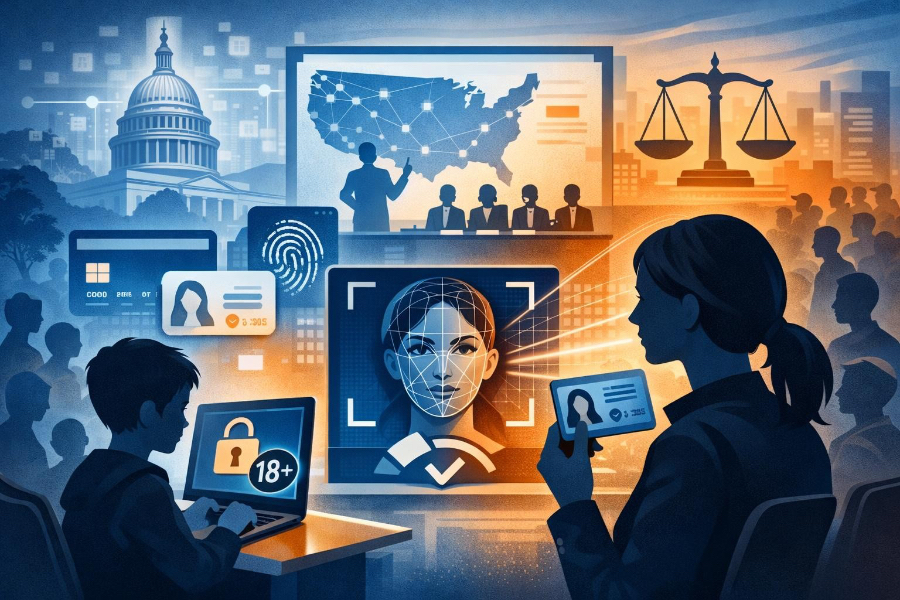
The Federal Trade Commission will host a workshop on January 28, 2026, examining age verification and estimation mechanisms, collectively known as “age assurance” tools. The workshop will explore practical implementation of these technologies and their relationship with current U.S. laws and regulations.
Age assurance encompasses different approaches to confirming or estimating users’ ages online. Age verification typically involves confirming a user’s age through identifiers such as government IDs, credit cards or social security numbers, while age estimation may use technical signals like AI-driven facial analysis to predict age without requiring formal documentation.
The workshop will examine how various age assurance methods are implemented at scale across different platforms. While much attention on children’s online safety has focused on the video game industry, the FTC noted that risks extend to companies operating mobile apps, social media platforms and other digital services where children are present.
Recent legislative efforts to address children’s online safety have faced significant legal challenges. California’s Age-Appropriate Design Code was blocked in September 2023 due to First Amendment concerns over invasive age estimation requirements. Most recently, Texas’s App Store Accountability Act was enjoined on December 23, 2025, with a court comparing it to requiring bookstores to verify every customer’s age and obtain parental consent for minors.
The workshop agenda indicates the FTC will examine specific existing tools and their real-world deployment rather than discussing age assurance in abstract terms. Panels will focus on current age assurance technologies, operational deployment by major platforms, and regulatory considerations involved in implementation.
As legislative solutions face First Amendment challenges, many companies in the gaming industry and other sectors have voluntarily adopted age assurance technologies to improve children’s safety. The FTC workshop signals that discussions around online safety continue to advance despite legal obstacles facing statutory requirements.