


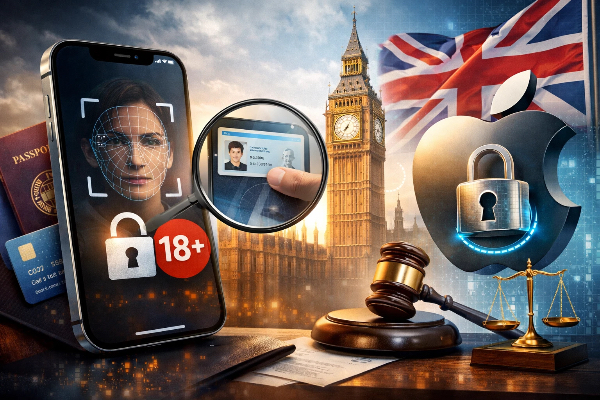

The UK’s Online Safety Act has created significant compliance challenges for global technology platforms, with early enforcement data showing both regulatory effectiveness and user adaptation patterns that could reshape how companies like Apple approach age verification requirements.
Cybersecurity experts note that international platforms serving UK audiences must comply regardless of their operational base. A platform operated from Silicon Valley with servers in Ireland but serving British users still falls under UK jurisdiction, creating compliance challenges that extend far beyond Britain’s borders.
Government guidance specifies that platforms must use secure verification methods including facial scans, photo ID checks, and credit card verification to confirm user ages. Companies face fines up to £18 million or 10% of global turnover, whichever is greater, while senior executives could face up to two years in prison for repeated breaches.
Ofcom is the United Kingdom’s communications regulator, responsible for overseeing television, radio, telecommunications, and online services. The organization enforces broadcasting standards, manages spectrum allocation, and under the Online Safety Act, has gained expanded powers to regulate digital platforms and social media companies operating in the UK, including authority to impose substantial fines and require compliance with age verification requirements.
The BBC confirms that Ofcom has already fined one company £50,000 for failing to implement proper age checks within months of the legislation taking effect. Ofcom’s guidance makes clear that self-declaration of age or simple terms of service agreements aren’t considered “highly effective” measures.
Apple now faces direct pressure to implement age verification systems into iOS and App Store infrastructure, a requirement that could fundamentally alter how iPhones handle user authentication and privacy. The Verge reports that similar legislation in Texas would require app store operators like Apple to verify user ages before allowing access to their platforms, with at least nine US states proposing legislation specifically targeting app stores.
The company told Texas legislators that age verification requirements “threaten the privacy of all users,” with CEO Tim Cook personally calling Governor Greg Abbott to request amendments or a veto. BBC analysis indicates that age verification methods might need integration directly into iOS, fundamentally changing how users interact with their devices.
Early enforcement data shows immediate impacts: Pornhub saw a 36% decline in unique visitors, while other major platforms experienced drops between 18% and 27%. However, The Guardian reports that VPN usage more than doubled immediately after enforcement began, jumping from 650,000 users to over 1.4 million by mid-August, though it has since declined to around 900,000 users.
Ipsos research reveals that while 69% of Britons support age verification checks in principle, only 48% say they would actually submit proof of age to access websites. Additionally, 68% of respondents are unlikely to use credit cards for verification, and 72% oppose using banking information.
Over 6,000 adult content sites have already adopted age verification measures to comply with UK rules, National Law Review analysis shows. The regulatory precedent is expanding rapidly, with Utah having already passed similar legislation and multiple other jurisdictions considering comparable measures.